When browsing the web, you have almost certainly come across a "404 Not Found" page, or perhaps run into the "500 Internal Server Error." Yet, there's one specific HTTP status code that has been sitting in the spec since the 1990s, reserved for future use but almost never used: 402 Payment Required.

Back when the internet was coming to life, serving content on the web was expensive and the financial incentive for hosting just wasn't there. The creators of the early web browsers wanted to make some kind of deal with payment providers like Visa and Mastercard to integrate payments natively into the browser. They imagined a future where internet traffic could be natively monetized through the browser, where a server could just say, "Pay me and I'll give you the content." However, that project failed, giving birth to what is often called the original sin of the internet. The envisioned future never arrived, primarily for two reasons:
- Google solved monetization with ads. Why charge users a fraction of a cent when advertisers would pay for their attention instead? While often annoying, ads became the glue that kept the web running, keeping it open and accessible to young people and developing nations.
- Serving costs collapsed. Hosting content became so incredibly cheap that charging users on a per-request basis stopped making sense for most websites. Payment friction, meanwhile, remained expensive, making per-request billing unattractive.
So 402 sat there dormant for three decades.
Then AI agents showed up.
The x402 Protocol
In 2025, Coinbase published a whitepaper introducing x402, a protocol that finally puts the 402 status code to work, this time for machine-to-machine micropayments.
x402 is an open payment standard enabling AI agents and web services to autonomously pay for API access, data, and digital services.
As the whitepaper puts it, "one of the major roadblocks to achieving fully autonomous AI systems is the lack of a payment system that empowers AI Agents to function without human intervention. Legacy payment systems are designed primarily for human interactions."
Today, AI agents are incredibly capable. They can research, write code, call APIs, and complete tasks autonomously. But the moment they need to pay for something, they are stuck.
Why Legacy Payments Don't Work for Agents
Traditional payment rails carry far too much legacy sophistication to work for autonomous software. Here is why the math on legacy micropayments simply never closes:
| Legacy Friction | The Bottleneck for AI Agents |
|---|---|
| Subscriptions | Forces an agent to commit to monthly billing for a resource it might only use once. |
| Manual Checkout | Requires a human to manually enter card details (which agents can't, and shouldn't, do). |
| High Fixed Fees | Stripe charges $0.30 + 2.9%. A $0.001 API call costs 300x more in fees than the actual data. |
| Slow Settlement | ACH transfers take 1–3 days to settle, forcing merchants to wait for their money. |
| Chargeback Risk | A 120-day risk window means payments can be reversed months after the resource is consumed. |
Because of these challenges, web services today are practically unusable for autonomous AI. They are stuck with clunky subscription models and weighed down by delayed settlement, high fees, and fraud risk.
An AI agent cannot open a bank account. Account opening is a legal act reserved for a "person." It cannot hold a card in its own name, pass a liveness check, or wait two days for ACH to clear. However, it can hold a key pair and sign messages.
Furthermore, even if AI-native services wanted to accept traditional card payments, existing processors would struggle to onboard them. Not because the technology is lacking but because of risk. When a processor approves a merchant, they take on that merchant's risk. Now picture the typical AI-native "merchant": a tool with no legal entity and no track record. If the merchant commits fraud or racks up chargebacks, the processor is on the hook. So processors reject applicants they can't underwrite. The legacy system isn't broken; it's working exactly as designed. It just wasn't designed for this.
Why Crypto Is the Only Option
Public blockchains are the only financial infrastructure where a key pair is treated as a first-class account holder. There is no onboarding and no paperwork; it is programmable by default and offers settlement finality in seconds. The machine economy did not choose crypto out of conviction. It chose the only settlement system whose minimum viable participant is software.
x402 is an open payments protocol powered by on-chain technology and stablecoins (primarily USDC). Compared to legacy rails, x402 transactions settle in roughly 200 milliseconds, providing instant finality for API providers.
How x402 Works
The protocol is beautifully simple. It is just HTTP, extended:
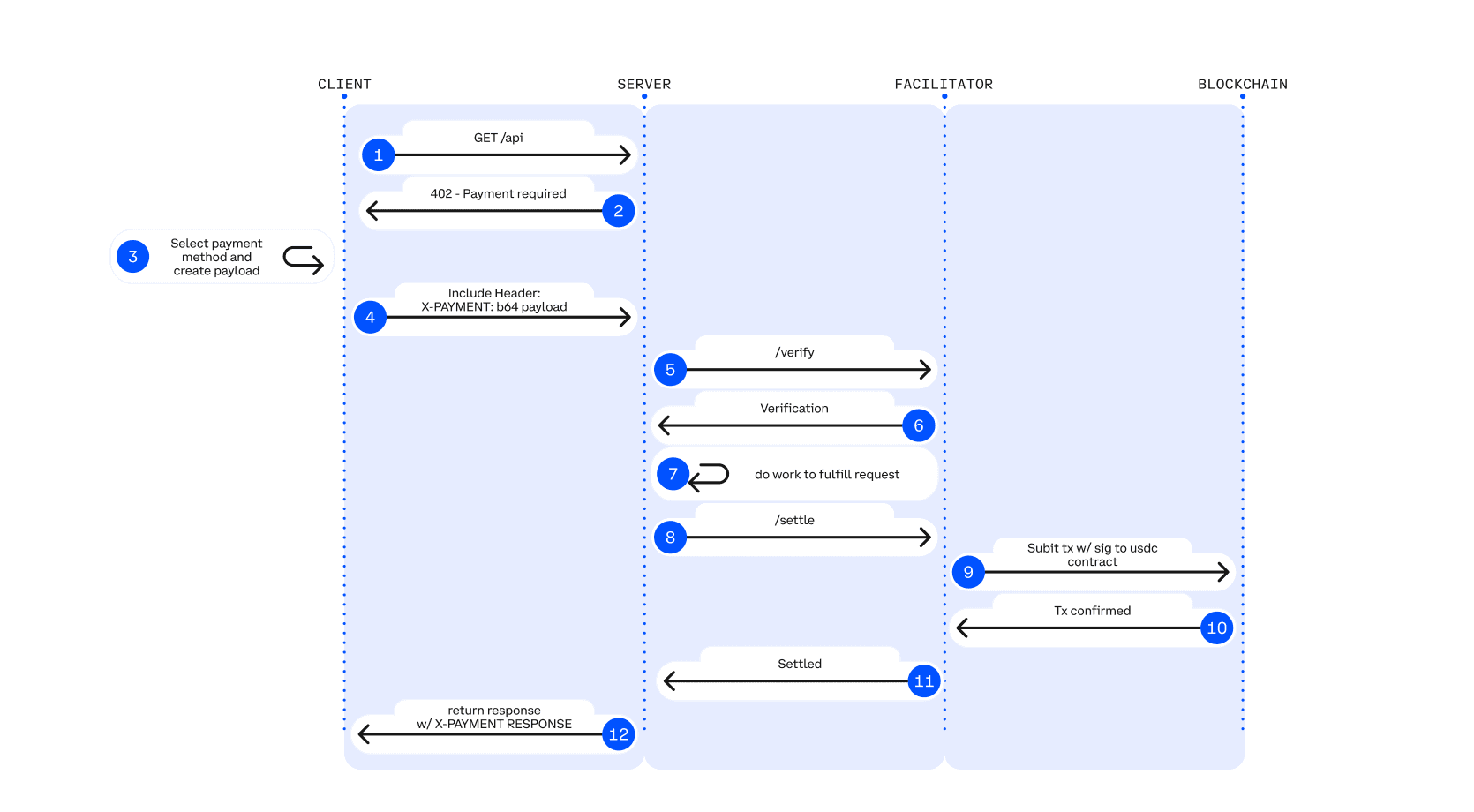
- The Request: The AI agent sends an API request to a server, just like normal.
- The Invoice: The server returns an HTTP 402 "Payment Required" status, along with machine-readable payment instructions.
- The Payment: The agent pays in USDC, signing the transaction and attaching proof to a retry request.
- The Settlement: Within ~200ms, the server verifies the payment, delivers the content, and the cycle is complete.
That initial 402 response isn't just an error; it's a dynamic, machine-readable invoice. Alongside a description of the resource, it carries an accepts array listing the ways the agent can pay, each defined by a few vital parameters:
amount: The price of the requested resource, in atomic token units.payTo: The wallet address where the funds should be sent.assetandnetwork: Which token to pay with (e.g., USDC) and on which chain.
The agent then signs a payment authorization, including a one-time nonce so the same payment can't be replayed, and attaches it to its retry request.
There are no account signups, API keys, card forms, or subscriptions. The agent simply hits an endpoint, gets quoted a price, pays it, and receives the data in a single request cycle.
The Role of Facilitators
To make this process seamless, x402 introduces facilitators, optional payment infrastructure that abstracts away the complexity of blockchain verification and settlement. Instead of requiring every API provider to verify on-chain payments and manage settlement logic, a facilitator acts as trusted financial middleware. When an AI agent receives a 402 Payment Required response, it signs the requested payment with its wallet and retries the request. The resource server can then either verify the payment itself or delegate that responsibility to a facilitator, which validates the payment, handles settlement, and returns the result. This allows developers to integrate machine-to-machine payments using familiar HTTP workflows without needing deep blockchain expertise, while keeping the protocol open. Anyone can run a facilitator, or choose not to use one at all.
Why This Matters
For AI agents: true autonomy. An agent can discover a paid API, evaluate the price, and transact with zero human intervention.
For the ecosystem: payments become permissionless, global, and instant. A developer in any country can spin up an API and start earning per-request, without a payment processor's approval, without waiting 3 days for settlement, and without chargeback exposure.
x402 provides a crypto-native payment standard that lets AI systems pay per API request, data query, or model inference with no pre-registered accounts, no card on file, no human in the loop. But the deeper shift is delegation: an agent holding a funded wallet no longer just thinks for us, it can act for us. It can research, decide, order, and pay completing an entire errand end to end while we sleep. This enables fully autonomous, AI-driven commerce, where agents operate independently in an on-demand, permissionless economy.
x402 in Action: Use Cases
At the time of writing, more than 45 million agentic transactions have settled on-chain. You can watch them live on Agentscan, an open observatory for agentic-commerce settlement that I have been contributing to the x402 ecosystem. Here is how AI agents (and humans) can put x402 to work:
Agents That Act on Your Behalf
With a funded wallet and a budget, a personal agent stops being a research tool and becomes a doer:
- Errands: "Find me the cheapest flight and book it." The agent compares fares, picks the seat, and pays, without ever asking for your card.
- Procurement: An agent watching your infrastructure buys extra storage or bandwidth the moment it's needed, staying within the budget you set.
- Research: Mid-task, an agent hits a paywalled paper or premium dataset, pays the few cents it costs, and keeps working instead of stopping to ask you.
The On-Demand Economy
Some of it is familiar commerce made frictionless; the most interesting part couldn't have existed before:
- Data & content on demand: An agent pays $0.25 for a premium article, $0.02 for a real-time stock quote, or $0.10 for a court ruling buying exactly the piece it needs instead of a bundled subscription. Coinbase's x402 Bazaar already indexes payable endpoints like these for agents to discover.
- Compute & inference: GPU power at $0.50 per GPU-minute, storage billed per GB, image classification at $0.005 a call, synthetic voice at $0.10 a clip without any enterprise tier or commitments. AWS's Bedrock AgentCore can already route agents to thousands of x402-paid tools.
- Pay-as-you-go media for humans: Video streamed per second watched, Substack articles at $0.25 apiece, podcasts per episode offering a frictionless alternative to memberships and ad-heavy platforms.
- Paid agent tools: MCP servers that quote a price per tool call, letting an agent rent a capability like a scrape, a search, or a transcription for a single invocation. API gateways like Zuplo already support x402-metered MCP tools.
- Agent-to-agent commerce: Agents hiring other agents, for example a research agent pays a translation agent per document, which in turn rents GPU time from a compute agent without human intervention. Google's agentic-commerce team has published an A2A x402 extension for exactly this.
- Pay-per-crawl: Publishers charge AI crawlers per page fetched. Cloudflare launched pay-per-crawl and has since expanded into its x402-based Monetization Gateway, turning scraping from a legal fight into licensing revenue. Stack Overflow already charges AI crawlers this way.
- Machine customers: Devices paying their own way for example, a drone buys charging time, a sensor pays for bandwidth, a robot pays another robot for a map of the room.
And this is no longer just a Coinbase project: as of July 2026, the x402 Foundation is operational under the Linux Foundation with 40 member organizations, including Visa, Mastercard, American Express, Stripe, Google, AWS, Shopify, and Cloudflare.
x402 is only one piece of the stack forming around agentic commerce. In the coming article, I will dive deeper into x402 in practice, alongside the other protocols racing to define how machines transact such as MPP (Machine Payment Protocol), A2A (Agent2Agent), UCP (Universal Commerce Protocol), and ACP (Agentic Commerce Protocol). Stay tuned.